
22 June 2026 · Flora Muijzer · 7 min read
Why your golf swing starts with your body: injury prevention and TPI screening on the Costa del Sol
Back pain, restricted swing, or golfer's elbow after 18 holes on the Costa del Sol? Here is how TPI body screening and targeted physiotherapy fix both the pain and the swing fault behind it.
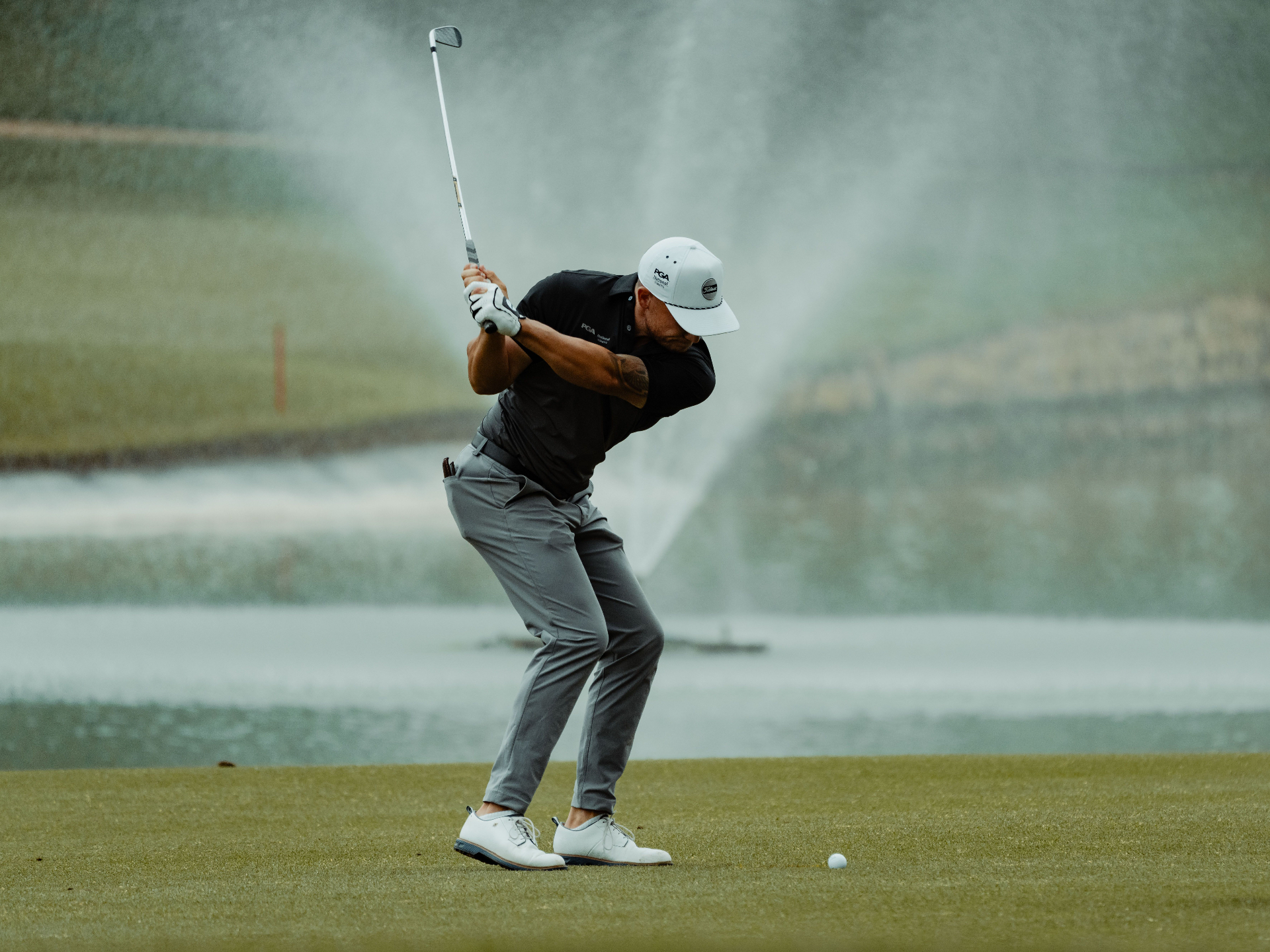
The Costa del Sol''s year-round golf season means high volume on the body — TPI body screening finds the physical limitations behind the swing faults.
It starts as a twinge in your lower back after 18 holes. Or maybe your ball striking has become inconsistent and you can''t figure out why. Perhaps your shoulder has been grumbling through every backswing for months. Whatever the sign, your body is telling you something important — and the answer is rarely in your grip or your stance.
Golf is one of the most technically demanding sports in the world. However, it is also one of the most underestimated when it comes to physical preparation. A full golf swing involves every major joint in the body firing in a precise sequence. When one link in that chain is stiff, weak, or restricted, another compensates. As a result, that compensation — repeated 80 or more times in a round — is exactly how golf injuries happen.
The good news is that most golf-related pain and performance problems are highly fixable. In many cases, addressing the physical limitation corrects the swing fault at the same time.
In this guide, you''ll find:
- The most common physical causes of golf injuries on the Costa del Sol
- How your body mechanics directly affect your swing
- How we assess and treat golfers at Physio Flora using the TPI method
- Three physiotherapist-approved exercises to improve your golf body today
- Answers to the questions our golf patients ask most
Why golf is harder on the body than most people realise
The golf swing is a rotational movement performed under significant load. In addition, it is highly asymmetrical — you repeat the same movement pattern on the same side, hundreds of times per round and thousands of times per season. Because of this, muscle imbalances and joint restrictions develop gradually and often go unnoticed until pain arrives.
The Costa del Sol is home to some of the finest golf courses in Europe. However, playing regularly on courses around Marbella, Sotogrande, and Mijas also means consistent physical demand on your body. Many of our patients play three or four rounds per week. That volume adds up quickly, especially if underlying restrictions are never addressed.
The three most common physical limitations in golfers we see at Physio Flora
Restricted thoracic rotation: the most overlooked cause of back pain in golfers
The thoracic spine — the mid-back — is where most of your rotation in the backswing should come from. However, if it is stiff from years of sitting, cycling, or poor posture, you will compensate elsewhere. The lower back, hips, and arms are forced to make up the difference. As a result, ball striking becomes inconsistent and lower back pain becomes almost inevitable.
This is one of the most common findings we see in golfers on the Costa del Sol. Fortunately, it also responds very well to targeted treatment and mobility work.
Limited hip internal rotation: why power leaks from your downswing
Being able to rotate your lead hip internally during the downswing is critical for effective power transfer. In contrast, when hip rotation is restricted — which is common in older golfers and those with desk-based jobs — the body compensates by finding rotation at the knee or lower back. Neither is designed for that job. Over time, therefore, this compensation leads to knee pain, lower back pain, or both.
Poor shoulder mobility and stability: the swing fault you cannot see
The trail shoulder needs sufficient mobility to reach a good backswing position. The lead shoulder, however, needs stability to control the downswing with precision. Imbalances between the two — often caused by asymmetric training or a previous injury — affect both consistency and injury risk. In addition, many golfers do not realise that their shoulder restriction is the root cause of their recurring back or neck pain.
How Flora assesses golfers: the TPI body screening explained
As a TPI Level 1 certified physiotherapist, Flora assesses the relationship between how your body moves and how you swing the club. The Titleist Performance Institute (TPI) method connects physical limitations directly to swing faults. Because of this connection, the results for golfers are often remarkable: fix the body, and the swing frequently corrects itself.
A TPI body screening at Physio Flora takes around 60 minutes. During the assessment, we work through 16 physical tests covering mobility, stability, and movement patterns that are specific to the golf swing. From the results, we build a personalised programme targeting your specific limitations. This includes mobility work, strength exercises, and movement drills you can do at home or at the range.
Over 15 years of working with athletes — including Ironman triathletes, Olympic-level competitors, and touring professionals — Flora has learned that the most effective approach is always individual. There is no generic golf fitness programme that works for everyone. However, there is a programme that works for your body. That is what we build together.
Three physiotherapist-approved exercises to improve your golf body today
These exercises address the three most common physical limitations in golfers. As a result, they are a good starting point for almost any golfer. However, if you are in pain, please book an assessment before beginning a new exercise programme.
-
Thoracic rotation in side-lying. Lie on your side with your knees stacked and bent to 90 degrees. Place both hands together in front of you. Slowly rotate your top arm open towards the ceiling, following it with your eyes. Hold for two seconds, then return. Do 10 repetitions on each side, twice daily. This exercise directly targets thoracic rotation, and it is one of the most impactful things a golfer can do off the course.
-
Hip 90/90 stretch for lead hip internal rotation. Sit on the floor with both legs bent to 90 degrees, one in front and one to the side. Sit tall and gently lean forward over your front shin. Hold for 30 seconds, then switch sides. In addition to improving hip rotation, this stretch reduces the compensatory load on the lower back during the downswing.
-
Shoulder wall slides for mobility and stability. Stand with your back against a wall. Press your arms against the wall in a goalpost position. Slowly slide your arms up the wall, keeping contact throughout. Return slowly. Do 10 repetitions. This exercise improves shoulder mobility on the trail side and trains scapular control on the lead side, addressing both shoulder requirements of the golf swing in a single movement.
Answers to the questions our golf patients ask most
Do I need to be in pain to benefit from a TPI screening?
No. In fact, many golfers come to us for performance reasons rather than pain. A TPI screening is just as valuable for someone looking to add distance or improve consistency as it is for someone managing an injury.
How many sessions will I need?
This depends on what we find. Some golfers see significant improvement within three to four sessions. Others with longer-standing restrictions may need six to eight. In all cases, however, the programme is designed around your specific findings, not a fixed protocol.
Can you help with golfer''s elbow?
Yes. Golfer''s elbow (medial epicondylalgia) is one of the most common overuse injuries we treat. However, because it is frequently caused by swing mechanics rather than grip strength alone, treatment that also addresses the underlying movement pattern tends to produce better long-term results.
Do you see golfers from courses across the Costa del Sol?
Yes. We see golfers from across the region, including Marbella, Sotogrande, Mijas, Fuengirola, Estepona, and Benalmádena. Our clinic in Riviera del Sol is conveniently located for golfers playing courses along the western Costa del Sol.
Golf injuries do not have to be part of the game
Many golfers accept pain as an inevitable part of playing regularly. However, it does not have to be that way. In most cases, the physical restrictions that cause golf injuries are entirely treatable. As a result, addressing them not only reduces pain — it also improves your game.
At Physio Flora, we combine thorough clinical assessment with evidence-based treatment and a genuine understanding of the active, outdoor lifestyle that brings people to, and keeps people on, the Costa del Sol. We see patients from Riviera del Sol, Marbella, Fuengirola, Estepona, Benalmádena, Mijas Pueblo, and across the region.
No referral needed. English-language consultations. Appointments available this week.
Website: www.physioflora.es
Phone: +34 711 059 592
Email: info@physioflora.es
Clinic locations: Riviera del Sol (Urb Balcon del Golf, c/ Topacio 2, local 1-2, 29649, Riviera del Sol, Mijas) & Marbella (inside: The Clubhouse Marbella, c/ Juan Belmonte, Nueva Andalusia)
Your best golf is still ahead of you — let''s make sure your body is ready for it.
Physio Flora · English, Dutch, German and Spanish-speaking physiotherapy on the Costa del Sol · Specialising in golf injury prevention, TPI body screening, sports performance, and back and neck pain