19 October 2026 · Flora Muijzer · 7 min read
Meniscus tears: why the type of tear decides whether surgery is even on the table
Torn meniscus or bucket handle tear? Physio Flora in Calahonda offers pre and post-surgical rehab, manual therapy, and return-to-sport coaching for knee injuries.
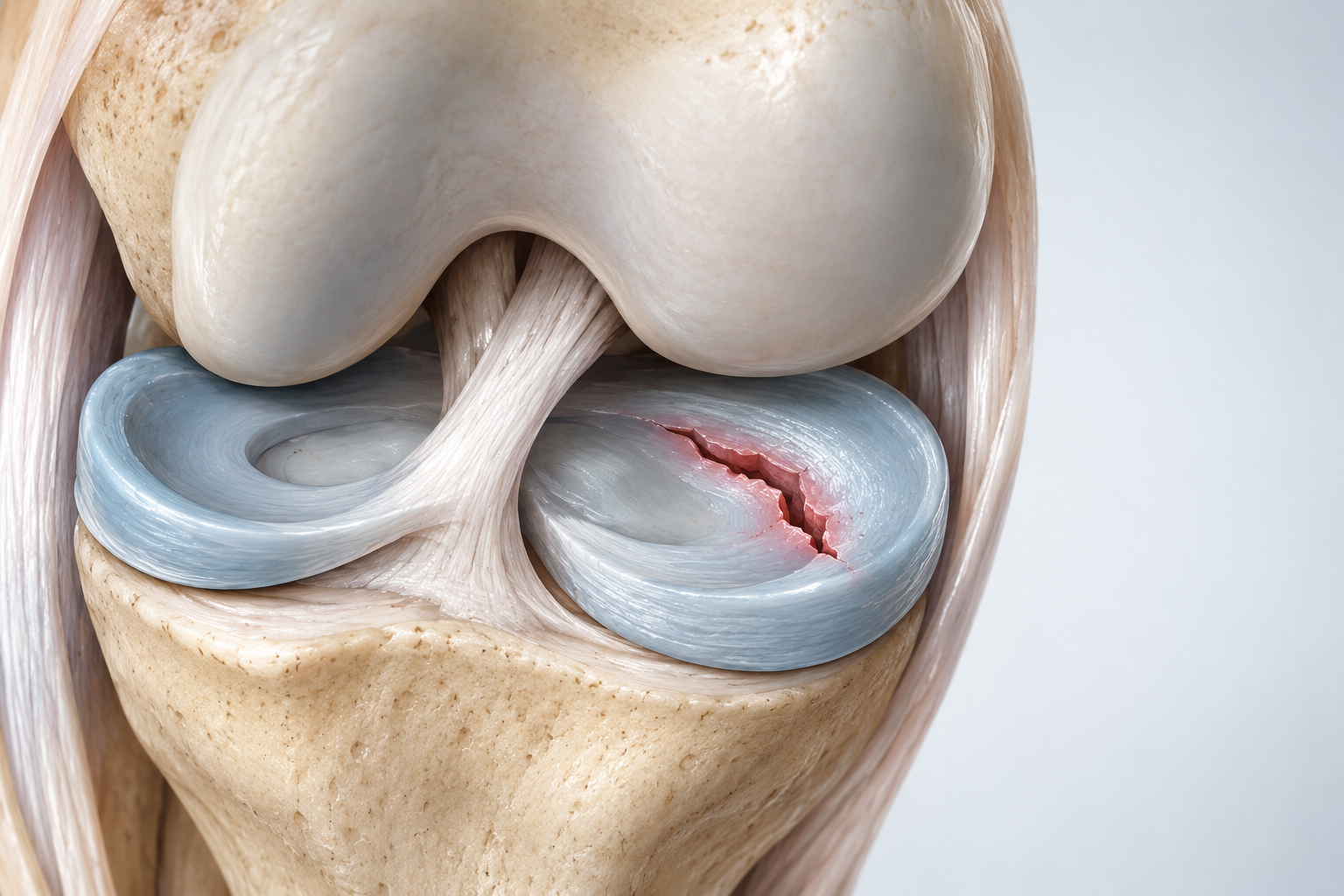
A torn meniscus affects the cartilage that cushions and stabilises the knee joint.
Roughly one in three knee injuries in twisting and contact sports involves the meniscus. However, not every tear behaves the same way, and the exact pattern of the tear often decides whether surgery is even necessary.
A torn meniscus sounds alarming, but most tears respond well to the right rehabilitation plan. Even when surgery is needed, physiotherapy still determines how fully the knee recovers afterward.
In this guide, you'll find:
- What a meniscus tear actually is, and why tear pattern matters
- What's happening in the tissue itself (with a deeper-dive option)
- Common causes of meniscus tears in football, padel, and skiing
- How we diagnose the root cause at Physio Flora
- Our physiotherapy treatment options for meniscus tears, including pre and post-surgical rehab
- Three physiotherapist-approved exercises to start today
- Answers to the questions our patients ask most
What is a meniscus tear?
Each knee has two menisci, C-shaped discs of cartilage that sit between the thighbone and shinbone. They cushion the joint, spread load evenly, and help stabilise the knee during twisting movements.
A tear usually happens when the knee twists while bearing weight, often with the foot planted. As a result, the cartilage splits rather than stretches, since meniscus tissue has very little give.
Not all tears look the same. A horizontal or radial tear stays in place and often causes localised pain and swelling. A bucket handle tear, however, is a longer vertical tear where a strip of cartilage flips into the joint like the handle of a bucket. This type frequently causes the knee to lock or catch, and it is far more likely to need arthroscopic surgery than a smaller, stable tear.
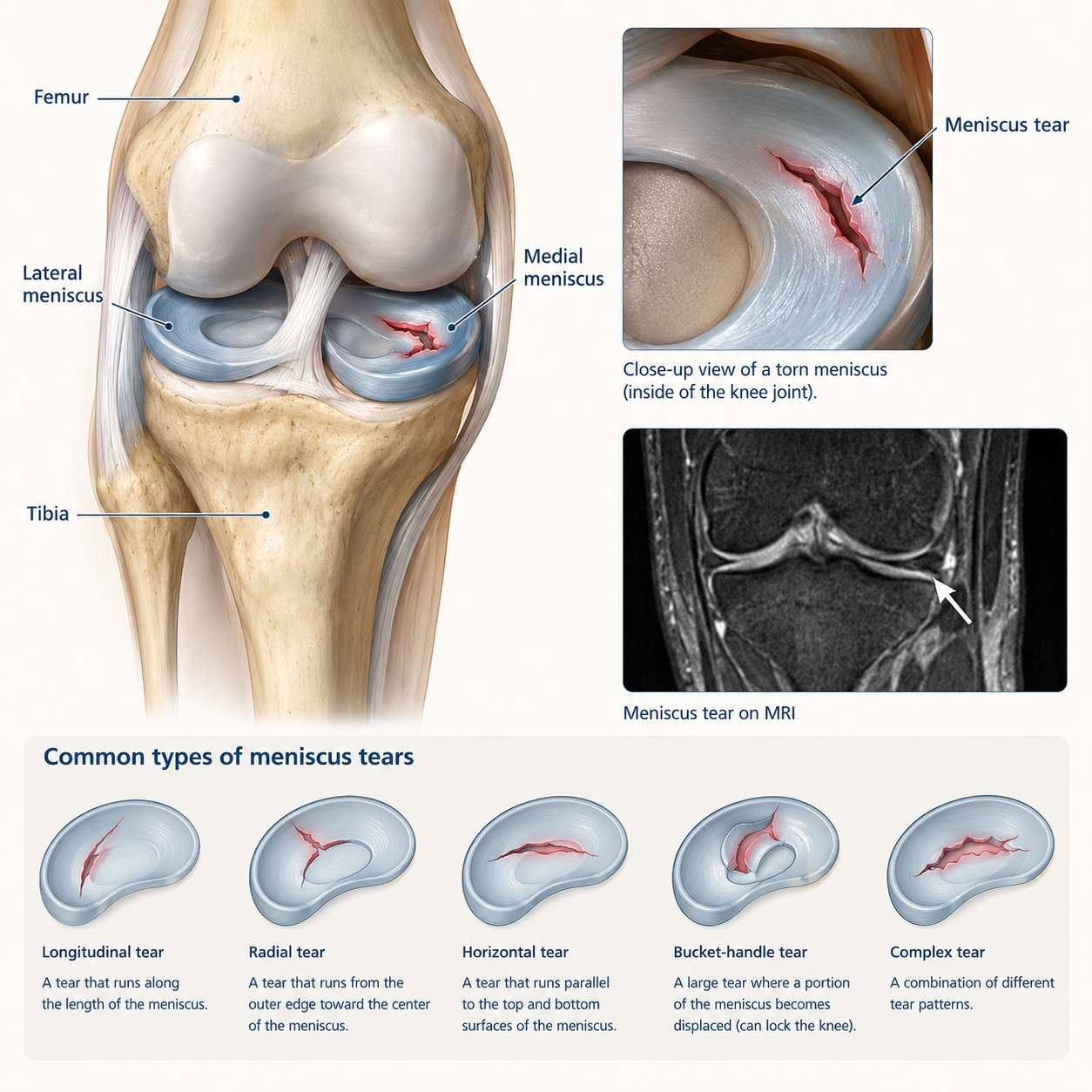 Meniscus anatomy and common tear patterns: the location and shape of a tear help guide treatment and rehabilitation.
Deep dive
Go deeper: the tissue science
This section goes deeper into the physiology for readers who want it. Skip ahead to "Common causes of meniscus tears" if you'd rather get straight to the practical guidance.
The meniscus is divided into zones based on blood supply. The outer third, called the red zone, has a reasonable blood supply and genuine capacity to heal. The inner two-thirds, called the white zone, receives nutrients mainly through joint fluid rather than direct blood flow, so healing potential there is minimal.
A tear in the red zone can sometimes be repaired surgically, since the tissue has the blood supply needed to knit back together. A tear confined to the white zone usually cannot heal on its own and, if it is causing symptoms, is more often trimmed away in a partial meniscectomy rather than repaired.
Bucket handle tears often cross both zones and displace into the joint space. Because the displaced fragment blocks normal joint mechanics, it frequently needs surgical repair or removal rather than a conservative approach, regardless of blood supply considerations.
Healing timelines vary sharply depending on the path taken. A stable, red-zone tear managed conservatively often settles within six to eight weeks. A meniscus repair, however, typically needs a protected loading phase of six to twelve weeks, since the repaired tissue needs time to re-establish its attachment before it can tolerate full weight-bearing rotation. A partial meniscectomy generally allows a faster return, often four to six weeks, since there is no repair site to protect, only a smaller, smoother remnant of cartilage to adapt to.
Common causes of meniscus tears in football, padel, and skiing
Most meniscus tears happen through one of two mechanisms. In younger, active patients, we commonly see:
- A sudden twisting movement with the foot planted, common in football, padel, and five-a-side sports
- A deep squat combined with rotation, which loads the meniscus at its most vulnerable angle
- A direct blow to the knee during a tackle or fall, which can tear the meniscus alongside ligament damage
Skiing adds its own pattern, since a twisting fall with the ski still attached transmits significant rotational force directly through the knee.
In older patients, however, the mechanism is often different. Degenerative tears can develop from ordinary daily movement once the cartilage has already thinned with age. In these cases, a tear sometimes shows up on imaging without a clear injury moment behind it, since the tissue was already weakened before the tear occurred.
How we diagnose the root cause at Physio Flora
Knee pain has several possible sources, so an accurate diagnosis is essential before starting treatment. Our assessment typically includes:
- McMurray's test and the Thessaly test, both designed to reproduce the catching or clicking sensation of a meniscus tear
- Joint line tenderness, checked precisely along the inner and outer edges of the knee
- A check for swelling, locking, or a block to full extension, which raises suspicion of a displaced bucket handle tear
- Range of motion and quadriceps strength testing, since both are commonly affected
- Screening of the surrounding ligaments, since meniscus tears frequently occur alongside ACL injury
Where locking, significant swelling, or a suspected bucket handle tear is present, we refer for MRI and an orthopaedic opinion before progressing rehabilitation further.
Our physiotherapy treatment options for meniscus tears
Treatment depends heavily on whether the tear is being managed conservatively or alongside surgery.
Pre-surgical rehabilitation. For tears heading toward arthroscopic treatment, we focus on reducing swelling and restoring range of motion beforehand. Patients who go into surgery with better strength and less swelling generally recover faster afterward.
Post-surgical rehabilitation. The plan differs significantly between a meniscus repair and a meniscectomy. A repair needs a staged, protected return to weight-bearing and rotation, while a meniscectomy allows a quicker progression toward strength and movement work, since there is no repair site to protect.
Manual therapy. Joint mobilisation reduces stiffness and helps restore full extension, which is often the last range of motion to return after a meniscus injury.
Dry needling. Targeted needling of the quadriceps addresses the reflex muscle inhibition that commonly follows a meniscus injury, helping restore normal activation more quickly.
Sports massage. Soft tissue work through the quadriceps and hamstrings supports swelling management and reduces compensatory tightness during rehabilitation.
Sports performance coaching. Once pain and swelling settle, we rebuild sport-specific movement, including cutting, pivoting, and landing mechanics, before clearing a return to football, padel, or skiing.
A stable, red-zone tear without locking often responds well to physiotherapy alone, without surgery. A displaced bucket handle tear, however, usually needs surgical input, and physiotherapy becomes the deciding factor in how well the knee recovers afterward.
Three physiotherapist-approved exercises to start today
Try these within a comfortable range, and stop if you feel sharp pain or locking rather than mild effort.
- Quad sets. Sit with your leg straight, and gently push the back of your knee into the floor while tightening your thigh muscle. Hold for five seconds and repeat ten times. This maintains quadriceps activation without loading the joint through rotation.
- Heel slides. Lying on your back, slowly slide your heel toward your buttock, bending the knee as far as comfortable, then slide it back out. This restores knee flexion range gently and safely.
- Straight leg raises. Lying flat with one knee bent for support, lift the other leg straight up to hip height, then lower slowly. Two to three sets of twelve repetitions build the quadriceps strength the knee needs for stability.
If any exercise triggers locking, catching, or sharp pain, stop and book an assessment before continuing.
Answers to the questions our patients ask most
Do all meniscus tears need surgery?
No. Many stable tears, especially in the outer red zone, respond well to physiotherapy alone. Surgery becomes more likely with locking, a displaced fragment, or a bucket handle pattern.
What exactly is a bucket handle tear?
It is a long vertical tear where a strip of cartilage flips into the joint space, similar to the handle of a bucket lifting away from its base. It often blocks full knee extension and frequently needs surgical repair.
How long does recovery take after arthroscopic surgery?
A meniscectomy often allows return to light activity within four to six weeks. A meniscus repair typically needs a longer, more protected timeline of three to four months before full sport-specific loading resumes.
Can a meniscus tear heal without surgery?
Tears in the outer red zone have a genuine capacity to heal, particularly with a structured rehabilitation plan. Tears confined to the inner white zone rarely heal on their own, though they do not always require surgery if symptoms stay manageable.
When can I return to football, padel, or skiing?
This depends entirely on the tear type and treatment path. We clear a return only once strength, range of motion, and sport-specific movement control have all been rebuilt, rather than by a fixed calendar date alone.
A meniscus tear does not have to end your season, whatever the tear pattern turns out to be.
At Physio Flora, we combine thorough clinical assessment with evidence-based treatment and a genuine understanding of an active lifestyle, wherever it's lived. No referral needed. Consultations available in English, Dutch, German and Spanish. Same-week appointments available.
Your knee carries every twist, pivot, and landing. Give it a recovery plan built around how it actually heals.
Physio Flora · English, Dutch, German and Spanish-speaking physiotherapy on the Costa del Sol · Specialising in knee injuries and pre and post-surgical rehabilitation