
25 May 2026 · Flora Muijzer · 9 min read
Why your shoulder hurts when you reach overhead (and what to do about it)
Shoulder pain reaching overhead, swimming or serving? A physiotherapist on the Costa del Sol explains the real causes and the treatment that actually works.
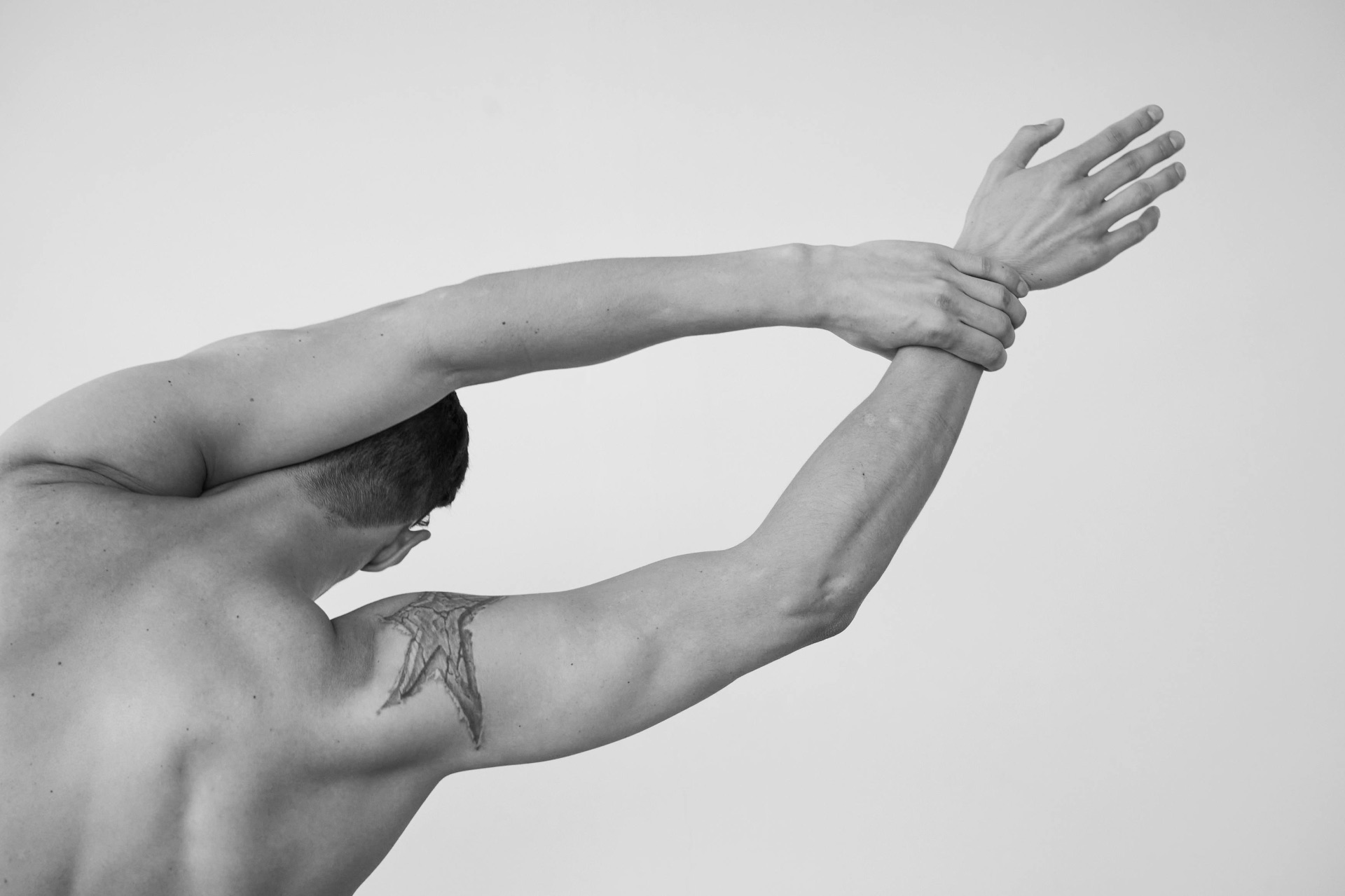
Overhead reaching is where most shoulder problems first show up — and where good rehab starts.
Reading time: approx. 9 minutes
Shoulder pain is one of the most common reasons people come to see me, and one of the most frustrating, because it tends to creep up gradually rather than arriving with a clear incident. You notice it first reaching for something on a high shelf. Then it is there during your swimming stroke, your tennis serve, or when you put on a jacket. Before long, you are sleeping on one side to avoid it and wondering how something so ordinary became so limiting.
The good news is that most shoulder pain, including the kind that has been grumbling for months, responds very well to the right approach. First, it helps to understand what is actually going on.
The shoulder is built for mobility, not stability
To understand why shoulders are vulnerable, it helps to appreciate what makes them remarkable. The shoulder is a ball-and-socket joint. Unlike the hip, however, the socket is remarkably shallow, which is what gives you the extraordinary range of motion to reach in almost any direction. The trade-off is that it relies heavily on the surrounding muscles and tendons to hold everything in place.
The rotator cuff, a group of four muscles that wrap around the shoulder joint, is the primary stabilising system. These muscles do not just move the arm. Their main job is to keep the ball of the humerus centred in the socket throughout every movement. When the rotator cuff is not functioning well, the mechanics of the entire shoulder change — and that is when things start to hurt.
What is shoulder impingement?
"Shoulder impingement" describes a situation where the tendons of the rotator cuff, most often the supraspinatus, become irritated as the arm is elevated. The pain is usually felt on the outer side or front of the shoulder, typically worst when reaching overhead, across the body, or behind the back. There is a characteristic painful arc, often between 60 and 120 degrees of arm elevation. Below and above that arc, things are often more comfortable.
The modern understanding has shifted away from the idea of mechanical pinching as the primary problem, and towards load management and tendon irritation as the more accurate explanation. The tendon is not being crushed. Instead, it is being repeatedly irritated by movement patterns that place too much demand on an under-prepared structure. This matters, because it changes how we treat it.
Common causes I see in clinic
Rotator cuff weakness
The most consistent finding in people with shoulder pain is weakness in the rotator cuff itself, particularly the external rotators, together with the lower fibres of trapezius and serratus anterior which control the shoulder blade. When these muscles cannot handle the load, the rotator cuff tendons end up working in a compromised position.
Poor scapular control
The shoulder blade is the foundation from which the rotator cuff works. If it is not tilting, rotating, and elevating in the right sequence as you raise your arm, the space available for the tendons narrows and muscle timing is off. Scapular control is something most people have never thought about, but it is often central to resolving shoulder problems.
A sudden spike in training load
This appears especially in summer, when people return to swimming, overhead gym work, or racket sports after a long break. Rotator cuff tendons adapt slowly. Increasing volume or intensity faster than the tendons can adapt is one of the most common triggers for shoulder pain in active people on the Costa del Sol.
Prolonged desk posture
Hours of sitting with the shoulders rounded forward changes the resting position of the shoulder blade and alters how the rotator cuff has to work. The desk is not the direct cause, but it creates conditions where the shoulder becomes more vulnerable.
What does not work, and why people keep doing it anyway
Resting completely
Painful shoulder? Rest it, surely. The problem is that tendons and muscles respond to load. They need progressive stimulus to remodel and strengthen. Complete rest removes that stimulus, and the shoulder returns to activity still unprepared for the demands placed on it.
Relying on anti-inflammatories alone
NSAIDs can help manage pain in the short term. However, they do not address the underlying mechanics. Used alone without rehabilitation, they are a temporary patch on a structural problem.
Cortisone injections as a first resort
Corticosteroid injections are sometimes appropriate when pain is severe and preventing engagement with rehabilitation. However, the evidence suggests they should be used as an enabler of rehab, not a substitute for it. Multiple injections into a tendon over time are associated with poorer long-term outcomes. If you have been offered one, it is worth asking whether a structured physiotherapy programme has been tried first.
What actually works
Targeted rotator cuff and scapular strengthening
This is the cornerstone of almost every shoulder rehabilitation programme I run, and the research backs it strongly. The goal is not to build big shoulder muscles. It is to restore normal timing, coordination, and strength in the structures that stabilise the joint.
Exercises I commonly use include:
- Side-lying external rotation — a deceptively simple but powerful exercise for the infraspinatus and teres minor, two of the most frequently underworked rotator cuff muscles.
- Band pull-aparts and face pulls — to activate the posterior rotator cuff and retrain the lower trapezius.
- Wall slides and serratus push-up plus — to improve scapular control and the upward rotation pattern essential for overhead movement.
- Isometric holds in pain-free positions — particularly useful early on when loading the tendon through range provokes too much pain.
The key is starting within a pain-free or low-pain range and building gradually. Forcing through sharp pain early in rehab consistently delays recovery.
Restoring range of motion
Stiffness in the shoulder joint, particularly in internal rotation and posterior capsule flexibility, is common in people with chronic shoulder pain. Gentle mobility work, including the cross-body stretch and sleeper stretch, can help restore this range. These should feel like a tolerable stretch, not pain.
 Restoring shoulder mobility — especially internal rotation — is one of the fastest ways to change how the shoulder feels overhead.
Addressing the whole chain
The shoulder does not operate in isolation. Thoracic spine stiffness — the mid-back becoming rigid from too much sitting — restricts how well the shoulder blade can move. I often spend as much time working on thoracic mobility in patients with shoulder pain as I do on the shoulder itself, because the results are frequently dramatic.
Similarly, in throwing and racket sports, shoulder injuries often have a contribution from the lower body. Inadequate hip and trunk rotation means the arm has to generate more force independently, increasing the load on the shoulder.
Load management
If you are training with a shoulder that is irritable, the answer is not necessarily to stop everything. It is to modify intelligently. This might mean temporarily reducing volume, avoiding specific aggravating movements (often internal rotation under load, or behind-the-head movements), and replacing those with pain-free alternatives that keep you training without making things worse.
A gradual return to overhead loading, guided by pain response, is usually achievable far sooner than most people expect.
When to see a physiotherapist for shoulder pain
Not all shoulder pain requires urgent attention, but some situations do warrant prompt assessment:
- Pain that has been present for more than six weeks without improvement.
- Significant weakness in the arm, particularly difficulty lifting the arm away from your side.
- Pain at rest or at night that is severe and does not settle with position changes.
- A history of trauma (a fall on an outstretched hand, direct impact) with sudden loss of strength.
- Any sign of joint instability — a feeling of the shoulder slipping or being about to come out.
The last two in particular should be assessed promptly, as significant rotator cuff tears and shoulder instability need different management from impingement.
How long does it take?
Mild to moderate impingement-related pain, addressed early with a good rehabilitation programme, often improves significantly within six to eight weeks. Chronic presentations — pain that has been present for six months or longer with significant strength deficits — typically take three to six months to fully resolve.
The sooner you start addressing the underlying mechanics rather than just managing pain, the faster and more completely you tend to recover. The shoulder wants to function well. It just needs the right conditions to get there.
Questions our patients ask most about shoulder pain
Is shoulder impingement the same as a rotator cuff injury?
They overlap but are not identical. Impingement describes an irritation of the rotator cuff tendons within their normal working space. A rotator cuff tear is actual structural damage to one of the tendons. Many people with impingement have no tear at all, and many people with small tears on scans have no pain. Assessment matters more than imaging alone.
Do I need an MRI before starting treatment?
Usually not. Most shoulder pain can be assessed and treated effectively based on clinical examination. Imaging becomes useful if symptoms fail to improve with rehabilitation, or if there are red flags such as significant weakness or trauma.
Can I keep swimming, playing tennis or padel while it heals?
Often yes, with modifications. We usually reduce volume, adjust technique on the aggravating strokes or shots, and keep pain-free training in place. Complete rest is rarely the best answer.
Will strengthening make my shoulder pain worse?
Well-dosed rehab exercises do not worsen shoulder pain — they are the single most effective treatment. Some low-level discomfort during and after exercise is normal. Sharp pain, or symptoms that stay elevated the next day, means the load is too high and should be reduced.
Do cortisone injections cure shoulder impingement?
No. They can reduce pain in the short term, which is sometimes useful to allow you to engage with rehabilitation. They do not fix the underlying mechanics, and repeated injections into a tendon are linked with poorer long-term outcomes.
Where can I get shoulder pain treatment on the Costa del Sol?
Physio Flora sees shoulder patients at our clinic in Riviera del Sol and inside The Clubhouse Marbella. We offer English-language consultations, no referral is needed, and appointments are usually available within the week.
The bottom line
Shoulder pain when reaching overhead is common, but it is not something you have to simply live with. In the vast majority of cases, a structured approach targeting rotator cuff strength, scapular control, and load management produces meaningful, lasting improvement — without surgery and often without injections.
If your shoulder has been limiting you, now is a good time to get it properly assessed. Summer sport is here, and you do not want to spend it on the sidelines.
At Physio Flora, we combine thorough clinical assessment with evidence-based treatment and a genuine understanding of the active, outdoor lifestyle that brings people to — and keeps people on — the Costa del Sol. We see patients from Riviera del Sol, Marbella, Fuengirola, Estepona, Benalmádena, Mijas Pueblo, and across the region.
No referral needed. English-language consultations. Appointments available this week.
Book online · Contact the clinic · Ask the Expert
Physio Flora · English, Dutch, German and Spanish-speaking physiotherapy on the Costa del Sol · Specialising in shoulder pain, tendinopathy and sports rehabilitation.