
28 September 2026 · Tetiana Koval · 6 min read
The physical toll of contest prep: what bodybuilding and bikini athletes put their bodies through
Each month, Physio Flora invites a specialist to share their expertise with our readers. This month, we welcome Tetiana Koval, Personal Trainer & Physiotherapist, who draws on her own background as a bikini fitness competitor to explain what contest prep really does to the body.
What does contest prep do to your body? Guest expert Tetiana Koval and Physio Flora explain the injury risks of bodybuilding and bikini competition prep.
In short: Contest prep combines a calorie deficit, high training volume, and repetitive isolation exercises, which together raise the risk of joint irritation, tendon overuse, and slower recovery. With the right load management and physiotherapy support, most competitors can prepare for a show without being sidelined by injury.
Most people see the stage photo. Very few see the months before it, when the body is pushed through a calorie deficit and a training volume that would be unsustainable at any other point in the year. As a former competitor and now a personal trainer and physiotherapist, I have felt this from both sides of the mirror.
Contest prep is not simply "training harder." It changes how your muscles, tendons, and joints recover, and that shift is exactly where most preventable injuries start.
In this guide, you'll find:
- What actually happens to the body during contest prep
- The most common causes of injury during a prep cycle
- How physiotherapy fits into a competitor's support team
- Three practical ways to protect your body during prep
- Answers to the questions competitors ask most
What is contest prep, physically speaking?
Contest prep is a structured period, typically lasting anywhere from 12 to 20 weeks, where a fitness competitor combines a calorie deficit with high-frequency, high-volume training to reduce body fat while preserving muscle. The exact duration depends heavily on the athlete's starting point, baseline conditioning, and overall training experience. Those stepping on stage for the first time, or starting from a higher body fat percentage, often require the longer end of that timeframe.
The training itself often involves the same isolation movements repeated several times a week, alongside cardio that increases as the show date approaches. As a result, specific joints and tendons absorb far more repetitive load than they would in an off-season programme.
Because the calorie deficit deepens over the weeks, the body has fewer resources available for tissue repair right when training demand is at its highest. This mismatch, more than any single exercise, is what drives most prep-related injuries.
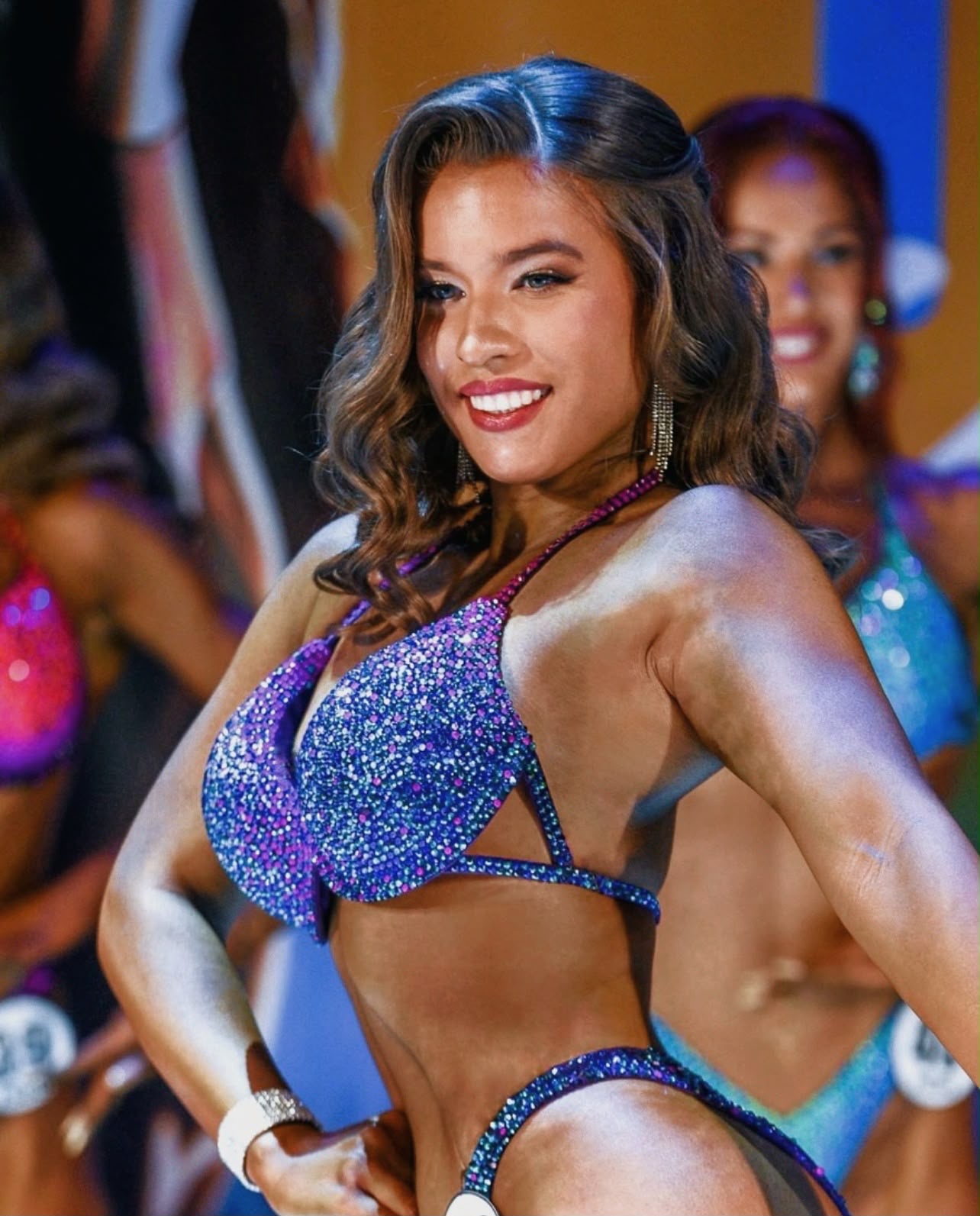
 Tetiana on stage during her bikini fitness competition.
Common causes of injury during contest prep
While progressive overload and movement consistency are the foundation of any successful prep, several compounding factors significantly raise injury risk as the show approaches:
- Accumulated structural fatigue from repetitive movement patterns. Sticking to your core foundational exercises is essential for tracking progress and driving hypertrophy. However, as weeks go by with zero off-seasons or deloads, the repetitive stress on specific tendons, such as patellar or rotator cuff tendons, accumulates, especially when systemic recovery drops.
- High cardio volume paired with deep fatigue. Increasing cardio late in prep is a mandatory tool for fat loss. However, doing high-impact or excessive volume on top of heavy training adds massive cumulative joint stress when the body's shock absorption is compromised.
- Deepening calorie deficit and depleted tissue repair. As caloric intake drops to minimal levels in the final weeks, the body's physiological capacity to repair micro-tears in tendons and ligaments slows down drastically.
- Compromised sleep and elevated systemic stress. High cortisol and poor sleep late in prep directly lower pain thresholds and impair soft-tissue recovery, turning minor joint stiffness into a persistent issue.
- Training through early warning signs. Pushing through an annoying ache in a joint because "it's just part of prep," rather than adjusting execution, tempo, or recovery protocols.
Because these factors build gradually, most competitors describe a joint that felt "a bit nagging" for weeks before it actually started limiting their performance.
How physiotherapy fits into a competitor's support team
Prep is usually coached closely for nutrition and training, but the physiotherapy side is often the missing piece. This is where a competitor's team and a clinic like Physio Flora work well together.
Movement and load assessment. Identifying which joints are compensating before they become painful, rather than waiting for an injury to force a change in programming.
Manual therapy. Addressing the joint stiffness and soft tissue tightness that build up from repeated isolation training, particularly around the shoulders, hips, and knees.
Dry needling. Releasing overworked muscle groups that carry disproportionate load during a prep cycle, which can reduce compensatory strain on nearby tendons.
Working alongside your coach, not around them. Adjusting exercise selection or tempo when a joint is irritated, without necessarily reducing total training volume, so prep can continue on schedule.
Post-show recovery planning. Supporting the transition back to a maintenance intake and more balanced training, since tissue repair capacity improves once the deficit ends.
The goal is not to add another restriction on top of an already demanding programme. It is to catch the small issues early, before they cost a competitor weeks of training close to a show date. Read more about sports injury prevention on the Costa del Sol and sleep and recovery in the guest series.
Three practical ways to protect your body during prep
-
Rotate your isolation exercises every few weeks. Swapping a barbell curl for a cable or dumbbell variation changes the exact angle of tendon loading, which gives overworked tissue a partial break without reducing training volume.
-
Flag joint pain in week one, not week six. A joint that feels slightly off after a session is far easier to manage early. Waiting until it affects your lifts usually means a longer recovery process later.
-
Protect sleep wherever possible in the final weeks. Even small improvements in sleep quality measurably improve tissue repair, which matters most exactly when your calorie intake is lowest.
If any joint pain sharply worsens or does not settle with a few days of modified training, it is worth a proper assessment rather than pushing through to the show.
Answers to the questions competitors ask most
Is it normal to feel more joint pain during prep than in the off-season?
Some increase in stiffness is common, since training volume rises while recovery resources fall. However, sharp or worsening pain is not something to train through and deserves a proper assessment.
Can physiotherapy help without reducing my training volume?
Often yes. Many issues respond well to manual therapy, targeted exercise substitution, and better recovery planning, rather than requiring a reduction in overall training load.
Why do injuries often show up in the final weeks before a show?
This is when the calorie deficit is deepest and cardio volume is highest, which is exactly when the body has the least capacity left for tissue repair.
Does this only apply to competitive bodybuilders?
No. Anyone doing an aggressive cut alongside high training volume, including general gym-goers preparing for a photoshoot or event, faces a similar pattern of risk.
What should I do differently after the show?
A gradual reverse diet, rather than an abrupt return to normal eating, gives tissue repair capacity time to recover alongside your energy intake.
Ready to transform your body safely?
Whether you are stepping onto the stage, or simply want to build a strong, aesthetic, and healthy physique under expert guidance here in Marbella, proper load management and a smart approach change everything.
Tetiana is a certified Personal Trainer and Physiotherapist based in Marbella. Connect with her via WhatsApp or follow her journey on Instagram to start training right.
WhatsApp: +34 641 128 309 / +380 99 290 4306 Instagram: @tanya_kvl
At Physio Flora, we see this kind of specialist load management as a genuine extension of physiotherapy, not separate from it. Working alongside a competitor's coach, rather than around them, is what keeps a prep cycle on schedule and off the treatment table.
No referral needed. Consultations available in English, Dutch, German and Spanish. Same-week appointments available.
Your body carries you through every rep of prep. Give it the support it needs to get you to the stage in one piece.