12 October 2026 · Flora Muijzer · 7 min read
Hip impingement: why the front of your hip catches, and how physiotherapy restores the movement
Struggling with hip impingement or FAI? Physio Flora in Calahonda treats hip pain in golfers, cyclists and triathletes with manual therapy and TPI screening.
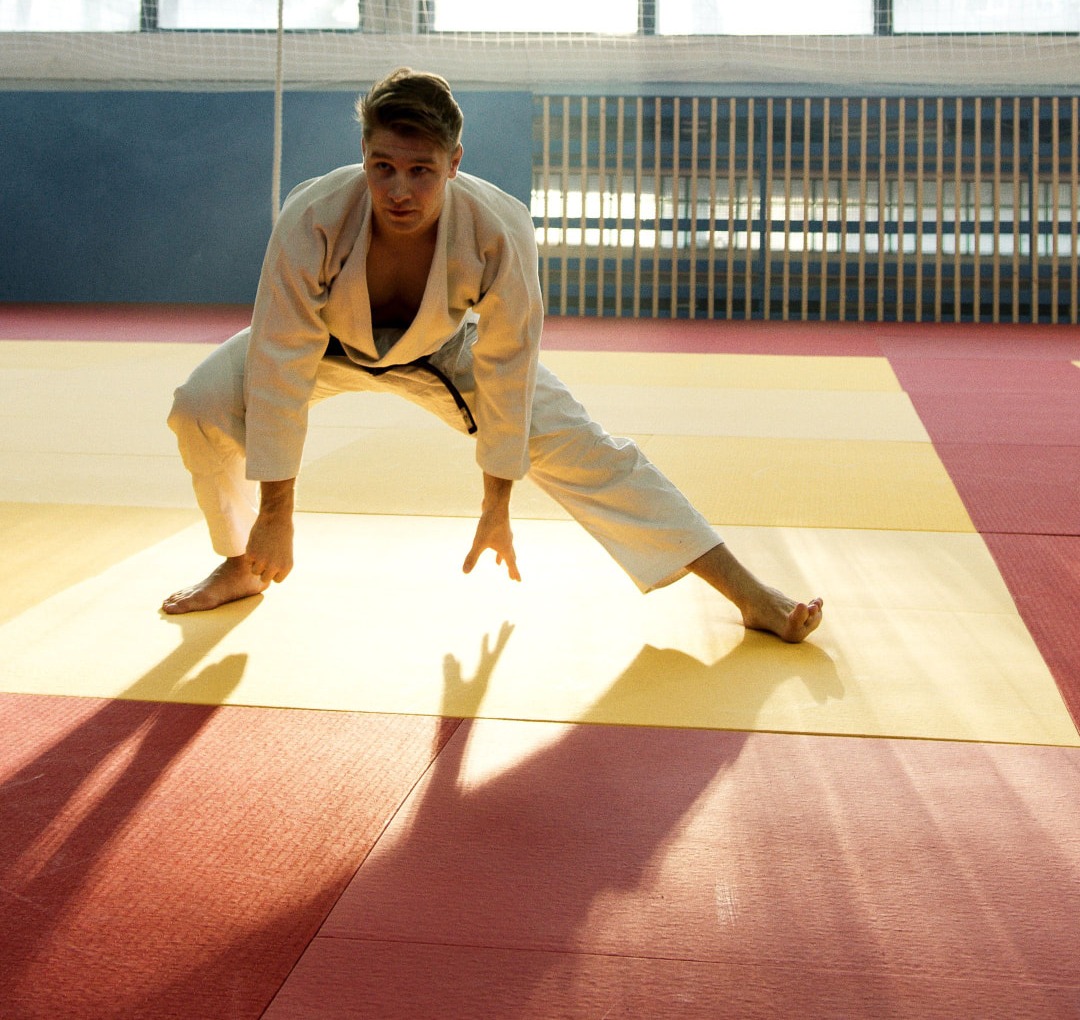
Hip mobility matters for comfortable movement in sport and everyday life.
Can you squat all the way down without your hip pinching in the crease at the front? For a large number of golfers, cyclists, and triathletes, the honest answer is no, and they have simply stopped noticing it.
That pinching sensation often points to hip impingement. The joint itself is rarely damaged beyond repair. However, without the right rehabilitation plan, the same catching pattern tends to resurface every time training load increases.
In this guide, you'll find:
- What hip impingement actually is
- What's happening in the joint itself (with a deeper-dive option)
- Common causes of hip impingement in golfers, cyclists, and triathletes
- How we diagnose the root cause at Physio Flora
- Our physiotherapy treatment options for hip impingement
- Three physiotherapist-approved exercises to start today
- Answers to the questions our patients ask most
What is hip impingement?
Hip impingement, known medically as femoroacetabular impingement or FAI, happens when the ball and socket of the hip joint make contact too early during movement. As a result, the labrum, a ring of cartilage that lines the socket, gets pinched between the bones.
Most people notice it as a deep ache or sharp pinch at the front of the hip or groin. It tends to appear during deep squatting, twisting through the trunk, or sitting for long periods. Some people also feel a catching or clicking sensation when they rotate the hip.
Unlike a torn muscle, FAI usually develops from a combination of bone shape and repeated movement. Therefore, treatment focuses on managing the mechanics around the joint rather than expecting the bone itself to change.
Deep dive
Go deeper: the tissue science
This section goes deeper into the physiology for readers who want it. Skip ahead to "Common causes of hip impingement" if you'd rather get straight to the practical guidance.
Three structures matter most in hip impingement. The femoral head and neck form the ball of the joint. The acetabulum forms the socket. Between them sits the labrum, a horseshoe-shaped rim of fibrocartilage that deepens the socket and helps seal the joint.
In a cam-type impingement, extra bone forms on the femoral neck, so it jams against the socket during hip flexion and rotation. In a pincer-type impingement, the socket itself covers too much of the femoral head, so the rim strikes the neck early in the movement. Many people have a mixed pattern of both.
Repeated contact compresses and shears the labrum against the bone. Over time, this causes fraying, small tears, and irritation of the joint lining, called synovitis. Because the labrum has a limited blood supply, especially toward its inner edge, it heals more slowly than muscle or skin.
Healing follows an uneven timeline here. Acute synovitis and capsule irritation typically settle within one to three weeks once the aggravating movement is reduced. Deeper labral irritation, however, often needs six to twelve weeks of guided loading before symptoms calm down. In addition, the underlying bone shape does not change with treatment. This is why rehabilitation targets the surrounding muscles and movement patterns, since these directly influence how much load the labrum absorbs.
Chronic cases behave differently from a recent flare-up. When symptoms have persisted for months, the deep hip rotators and hip flexors are often protectively tight. Consequently, the rehabilitation plan needs to address that guarding before strength work can progress comfortably.
Common causes of hip impingement in golfers, cyclists, and triathletes
Certain movement patterns place repeated stress on the front of the hip joint. In golf, the following factors are especially common:
- A swing that relies on excessive hip rotation, rather than sharing the load through the trunk and shoulders
- Limited hip internal rotation, which forces the joint to work at its end range on every swing
- A steep increase in practice volume, particularly at the start of a new season
Cyclists and triathletes face a different, but related, demand. A sustained aerodynamic position holds the hip in deep flexion for long periods. Furthermore, a saddle that sits too low or too far forward increases hip flexion angle with every pedal stroke. Long training blocks without adequate mobility work compound this further.
Beyond sport, prolonged sitting, limited hip mobility, and underlying bone shape all contribute. Because the cause is usually a mix of anatomy and repeated positioning, symptoms typically build gradually rather than appearing after one specific movement.
How we diagnose the root cause at Physio Flora
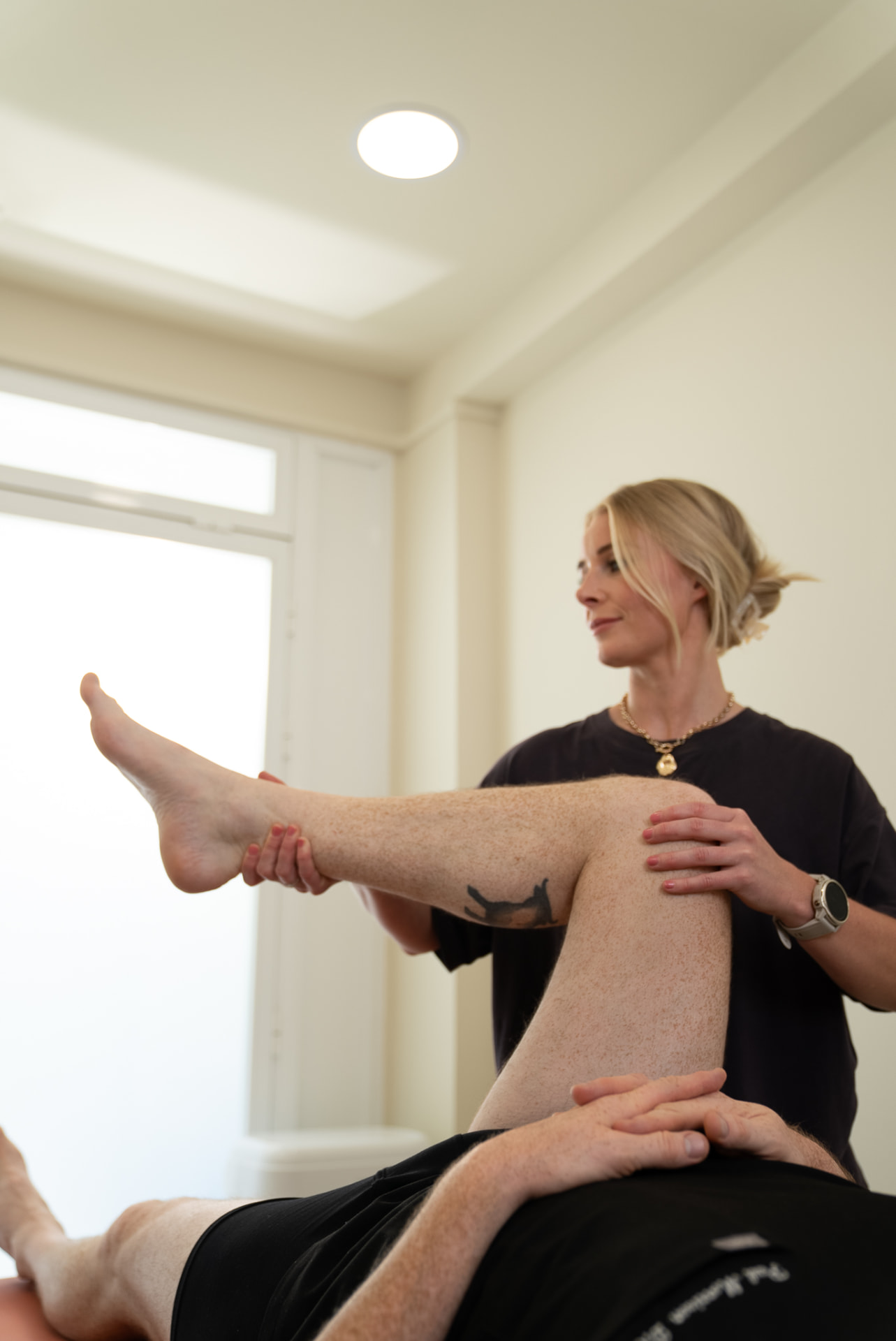 Flora performs a hip examination to assess movement and identify the source of discomfort.
Hip pain has several possible sources, so an accurate diagnosis is essential before starting treatment. Our assessment typically includes:
- The FADIR test, which combines hip flexion, adduction, and internal rotation to reproduce the pinching sensation
- Hip internal and external rotation range of motion, compared side to side
- A movement screen of the golf swing or pedal stroke, since technique often drives the repeated loading pattern
- Screening of the lumbar spine and sacroiliac joint, because pain can be referred from either area
- A check of core and gluteal control, since weakness here often forces the hip into a compensatory range
For golfers specifically, we also assess hip rotation using our TPI-informed screening process. This identifies whether limited hip mobility is forcing the lower back or shoulders to compensate during the swing.
Our physiotherapy treatment options for hip impingement
Treatment is built around reducing irritation first, then rebuilding the hip's capacity to move and rotate under load.
Manual therapy. Joint mobilisation techniques improve the available range of motion in the hip capsule and reduce the guarding that builds up around an irritated joint.
Dry needling. Targeted needling of the hip flexors, deep rotators, and surrounding musculature releases the protective tightness that often accompanies chronic impingement.
Movement-pattern correction. Using an EXOS-informed approach, we retrain hip hinge mechanics and glute activation. This reduces the amount of rotation the hip joint itself has to provide during a golf swing, pedal stroke, or run stride.
TPI-guided swing adjustments. For golfers, we work directly on the hip rotation deficits that a standard screening reveals, adjusting swing mechanics so the joint is no longer forced into its most irritated range.
Sports massage. Releasing tension through the hip flexors, adductors, and glutes supports the other treatments and reduces discomfort between sessions.
Sports performance coaching and training plans. For cyclists and triathletes, this includes reviewing saddle height and position, alongside a structured strength programme that builds tolerance for the aero position over time.
We do not rely on joint manipulation alone for this condition, since the underlying bone shape does not respond to manual technique. Instead, the emphasis stays on the muscles, control, and movement patterns that determine how much stress the joint absorbs day to day.
Three physiotherapist-approved exercises to start today
Try these within a comfortable range, and stop if you feel sharp pinching rather than mild stretch or effort.
-
90/90 hip rotation stretch. Sit on the floor with one leg bent in front of you and the other bent behind, both at roughly ninety degrees. Lean gently forward over the front leg and hold for thirty seconds. This restores rotation range without forcing the joint into a painful position.
-
Glute bridge with band. Lie on your back with a resistance band around your knees, feet flat on the floor. Push through your heels to lift your hips, pressing your knees gently outward against the band. Two to three sets of twelve repetitions build the gluteal control that protects the front of the hip.
-
Controlled hip circles. On all fours or standing, move one knee slowly through a full circle, staying within a pain-free range throughout. This trains the joint to move actively through rotation, rather than avoiding it altogether.
If any exercise reproduces a sharp pinch at the front of the hip, stop and book an assessment before continuing.
Answers to the questions our patients ask most
Is hip impingement the same as a labral tear?
Not exactly. Impingement describes the mechanical process of bone contacting bone. A labral tear can be one consequence of that repeated contact, but not everyone with impingement develops a tear.
Can I keep playing golf or cycling with hip impingement?
Often yes, with adjustments. We usually recommend modifying swing mechanics or bike position, alongside targeted strengthening, rather than stopping the activity altogether.
How long does conservative treatment take?
Mild irritation often improves within four to six weeks. Chronic cases, especially those involving labral irritation, typically need three to four months of structured rehabilitation to see lasting change.
Do I need surgery for hip impingement?
Most cases respond well to physiotherapy alone. Surgery is generally reserved for cases with significant structural damage that have not improved after a genuine course of conservative treatment.
Is hip impingement caused by poor posture?
Posture plays a smaller role than most people expect. Bone shape and repeated movement patterns, particularly in golf and cycling, matter far more than how you stand or sit.
Hip impingement does not have to keep you off the course, the bike, or the start line.
At Physio Flora, we combine thorough clinical assessment with evidence-based treatment and a genuine understanding of an active lifestyle, wherever it's lived. No referral needed. Consultations available in English, Dutch, German and Spanish. Same-week appointments available.
Your hips carry every rotation, stride, and pedal stroke. Give them room to move freely again.
Physio Flora · English, Dutch, German and Spanish-speaking physiotherapy on the Costa del Sol · Specialising in hip, golf swing, and endurance sport rehabilitation