14 September 2026 · Flora Muijzer · 7 min read
Runner's knee: why pain under the kneecap keeps coming back, and how physiotherapy treats it
Kneecap pain when running or on stairs? Physio Flora explains the causes of runner's knee and offers targeted physiotherapy in Marbella and Mijas.
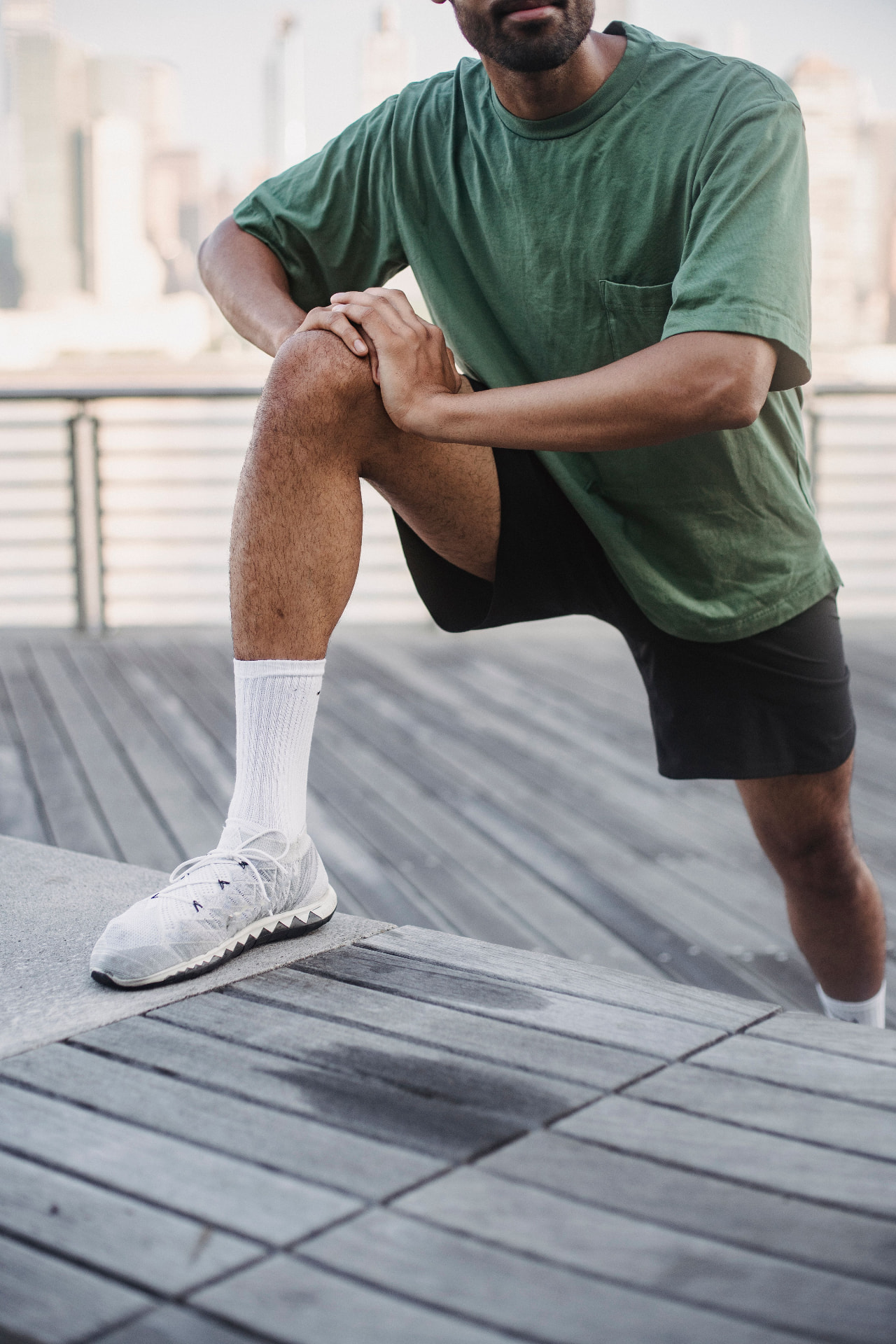
Pain around or behind the kneecap is common in runners, but a structured strength and load plan can help it settle and stay settled.
Roughly a quarter of all running injuries involve pain around or behind the kneecap. Most runners call it runner's knee. Physiotherapists call it patellofemoral pain syndrome, and it rarely means anything is torn or damaged.
Instead, the joint under the kneecap is simply being asked to absorb more load than it currently tolerates. As a result, the fix is not rest alone. It is a structured plan that rebuilds tolerance in the muscles that control the knee.
In this guide, you'll find:
- The most common causes of patellofemoral pain
- What's actually happening in the joint, with a deeper-dive option
- How we diagnose the root cause at Physio Flora
- Our physiotherapy treatment options for runner's knee
- Three physiotherapist-approved exercises to start today
- Answers to the questions our patients ask most
What is patellofemoral pain syndrome?
Patellofemoral pain syndrome describes pain at the front of the knee, centred around or just behind the kneecap. It typically flares during activities that load the joint at a bent angle: running, squatting, kneeling, and walking down stairs. Sitting for long periods with the knee bent, such as on a flight, can also trigger it.
Despite the name, "runner's knee" affects far more than runners. Hikers, cyclists who stand to climb, and anyone who suddenly increases squatting or stair-based training can develop it too. However, the underlying story is usually the same: the kneecap is tracking unevenly through its groove in the thigh bone, and the surrounding tissue is reacting to that uneven load. Pain on the outside of the knee may instead point to IT band syndrome, while cyclists with front-of-knee pain may benefit from our guide to cyclist's knee.
Deep dive
Go deeper: the tissue science
This section goes deeper into the physiology for readers who want it. Skip ahead to "Common causes" if you'd rather get straight to the practical guidance.
The patellofemoral joint is where the back of the kneecap glides against a groove in the femur, called the trochlear groove, every time the knee bends and straightens. That gliding surface is covered in articular cartilage, a smooth, shock-absorbing tissue with very little blood supply of its own. Because of this, it cannot repair itself the way muscle or skin can.
Surrounding the joint is the fat pad, the synovial lining, and the retinaculum, a sheet of connective tissue that helps guide the kneecap's path. When load increases faster than these tissues can adapt, two things tend to happen. First, the kneecap tracks slightly off-centre, often pulled laterally by a tight IT band or an underactive inner quadriceps muscle. Second, the fat pad and synovium become irritated and inflamed, which is usually where the pain signal actually comes from.
Healing follows a layered timeline. The inflammatory response in the fat pad and synovial lining settles within roughly 5 to 10 days once the aggravating load is reduced. The proliferative phase, where the quadriceps, hip muscles, and tendons rebuild strength and better control the kneecap's path, takes about 5 to 8 weeks of consistent, progressive loading. Full remodelling, where the joint reliably tolerates running and stair loading again without flaring, generally takes 3 to 6 months. This is longer than many patients expect, because cartilage and connective tissue adapt more slowly than muscle. Chronic cases that have been present for over a year often need a longer, more gradual return-to-load plan than a recent, first-time flare.
Common causes of patellofemoral pain
Patellofemoral pain rarely comes from a single event. In addition, it usually develops from a combination of the following factors.
A sudden jump in training load. Adding too many kilometres, too many hills, or too many stairs too quickly overwhelms the joint's current tolerance.
Weak hip abductors and external rotators. When the glutes cannot control the thigh bone properly, the knee tends to drift inward with every stride, pulling the kneecap off its ideal path.
An underactive inner quadriceps muscle. The vastus medialis obliquus, or VMO, is a key stabiliser for the kneecap. If it fires late or weakly, the outer quadriceps and IT band pull the kneecap sideways.
Tight lateral structures. A stiff IT band or tight lateral retinaculum increases sideways pull on the kneecap during movement.
Foot mechanics. Excessive inward rolling of the foot, or overpronation, changes the alignment of the whole leg and adds rotational stress at the knee.
Previous knee injury. An old ankle, hip, or knee issue can leave behind movement compensations that quietly overload the patellofemoral joint years later.
How we diagnose the root cause at Physio Flora
An accurate diagnosis starts with a detailed movement assessment, not just an examination of the sore spot. We watch how a patient squats, steps down from a box, and, where relevant, runs, because the knee is often the victim of a problem sitting higher up the chain at the hip.
We also test hip abductor and external rotator strength directly, check quadriceps activation patterns, and assess ankle and foot mechanics. Because dynamic knee valgus, the inward collapse of the knee during loading, is one of the strongest predictors of patellofemoral pain, we pay particular attention to how the knee behaves under a single-leg load rather than in a resting position.
This approach matters because two people with identical kneecap pain can have entirely different root causes. Therefore, treatment that starts with a genuine movement assessment tends to resolve faster and stay resolved.
Our physiotherapy treatment options for runner's knee
Treatment for patellofemoral pain combines several of Flora's core techniques, matched to what the assessment finds.
Manual therapy. Hands-on mobilisation of the kneecap and soft tissue work on the IT band, lateral retinaculum, and quadriceps reduce excess lateral pull and improve how freely the joint moves.
Targeted strengthening. A progressive programme for the hip abductors, external rotators, and VMO rebuilds the control needed to keep the kneecap tracking centrally. This is the single most evidence-backed part of recovery.
Dry needling. For patients with tight, overactive quadriceps or IT band tissue, dry needling can reduce muscular tension and improve the immediate response to strengthening work.
Short-term patellar taping. Taping techniques can reduce pain during the early, most irritable phase, which allows patients to keep moving and training with less discomfort while strength rebuilds underneath.
Sports performance coaching. For runners and triathletes, we build a structured return-to-load programme, adjusting mileage, hill work, and stair training in a way that respects the joint's current tolerance while still moving the athlete forward.
Three physiotherapist-approved exercises to start today
- Side-lying hip abduction. Lying on your side, lift the top leg slowly with the knee slightly bent, keeping the hip stacked directly above the other. Perform 3 sets of 12 to 15 per side. This targets the glute medius, one of the main stabilisers that keeps the knee from drifting inward.
- Slow step-downs. Stand on a low step and lower the opposite heel toward the floor with control, tapping it lightly before returning up. Keep the knee tracking over the middle toes throughout. Start with 3 sets of 8 per leg, focusing on control rather than speed.
- TKO's (end range knee extension with a band). Loop a resistance band around a fixed point at knee height, step back to create tension, and straighten the knee against the band's pull while keeping the thigh muscle engaged. This activates the VMO specifically. Aim for 3 sets of 12.
If any of these exercises sharply increase pain, however, stop and book an assessment rather than pushing through.
Answers to the questions our patients ask most
Can I keep running with runner's knee?
Often yes, but usually at reduced volume or intensity at first. Because pain is a signal to respect rather than ignore completely, we typically guide patients through a modified running plan rather than a full stop, unless the pain is severe.
Does runner's knee mean I'm developing arthritis?
Not usually. Patellofemoral pain syndrome is a load and tracking issue, not a degenerative joint disease. In contrast, arthritis involves structural cartilage loss visible on imaging, which is a separate diagnosis with different management.
How long does recovery actually take?
Most patients notice meaningful improvement within 6 to 8 weeks of consistent treatment and exercise. However, full resolution and a confident return to unrestricted training often takes 3 to 6 months, in line with the tissue healing timeline above.
Do I need an MRI to diagnose this?
Rarely. Patellofemoral pain syndrome is diagnosed through clinical assessment and movement testing. Imaging is reserved for cases that do not respond as expected, or where another injury is suspected.
Will orthotics or new running shoes fix it?
They can help as one part of a broader plan, particularly if overpronation is a contributing factor. On their own, however, they rarely resolve the underlying strength and control deficits that caused the problem in the first place.
Kneecap pain does not have to end your running season.
At Physio Flora, we combine thorough clinical assessment with evidence-based treatment and a genuine understanding of an active lifestyle, wherever it's lived. No referral needed. Consultations available in English, Dutch, German and Spanish. Same-week appointments available.
Your knees carry every stride you take. Give them a plan built to keep up.
Physio Flora · English, Dutch, German and Spanish-speaking physiotherapy on the Costa del Sol · Specialising in running and endurance sport injuries