
27 July 2026 · Flora Muijzer · 7 min read
Postural pain: why your neck and back ache after a day at the laptop
Neck or back pain from working at a laptop in Marbella or Mijas? Physio Flora treats postural pain with the McKenzie method, manual therapy and dry needling.

Hours spent working from a sofa or armchair load the neck and upper back far more than most people realise.
The human head weighs around five kilograms, roughly the weight of a bowling ball. Tilt it forward to look at a screen, and the effective load your neck muscles must support multiplies several times over.
Postural pain is rarely about a single bad habit. It is a mechanical problem with a clear physical cause, and a clear, structured way to resolve it.
In this guide, you'll find:
- What postural neck and back pain actually is
- What's actually happening in the discs and muscles, with a deeper-dive option
- Why remote and office workers are especially at risk
- How we diagnose the root cause at Physio Flora
- Our physiotherapy treatment options, including the McKenzie method
- Three physiotherapist-approved exercises to start today
- Answers to the questions our patients ask most
What postural neck and back pain actually is
Sustained positions, such as sitting at a laptop with your head forward and shoulders rounded, place steady mechanical stress on specific spinal segments. Over hours, this stress irritates the joints, discs, and surrounding muscles of the neck and lower back.
This pattern has a name in clinical practice: postural syndrome, sometimes alongside "text neck" or upper crossed syndrome, where the chest muscles tighten while the muscles between the shoulder blades weaken. Because the cause is mechanical and repetitive, the pain typically builds through the day and eases somewhat overnight. This is a useful clue, since it distinguishes postural pain from other, more serious causes of back and neck pain.
Deep dive
Go deeper: the tissue science
This section goes deeper into the physiology for readers who want it. Skip ahead to "Why remote and office workers are especially at risk" if you'd rather get straight to the practical guidance.
Two structures do most of the work of holding you upright against gravity for hours at a time: the intervertebral discs and facet joints of the spine, and the postural muscles of the neck and upper back.
When you sit with your head and shoulders forward, the front of each disc compresses while the back portion, called the anulus fibrosus, is placed under tension. Held over hours, this asymmetric loading is exactly what the McKenzie method targets, since repeated extension movements reverse the pattern and can centralise pain that has spread outward from the spine.
The disc itself has almost no direct blood supply. It is the largest avascular structure in the human body, and instead relies on nutrients diffusing in and out through repeated compression and decompression, essentially a pumping action driven by movement. Sustained static sitting blocks this pump. That is part of why prolonged stillness, not only poor alignment, contributes to stiffness.
Meanwhile, the small postural muscles of the neck and upper back, particularly the upper trapezius and levator scapulae, stay in continuous low-level contraction to hold your head up against that forward load. Physiologists sometimes call this the "Cinderella fibre" effect: the same small set of muscle fibres stays switched on constantly, without ever fully resting the way they would during varied, dynamic movement. That ongoing low-grade reduction in local blood flow produces the dull, aching quality typical of postural muscle pain, quite different from the sharp pain of an acute strain.
Because there is no discrete tear to repair here, postural pain does not follow the standard injury-healing timeline of inflammation, repair, and remodelling. Instead, recovery follows an adaptation timeline. Muscles and the nervous system typically need two to six weeks of consistent corrective loading and postural change to desensitise and rebuild endurance capacity, which is why the exercises later in this guide are dosed for frequent repetition rather than heavy load.
Why remote and office workers are especially at risk
- Laptop-first working habits. Many people now work from a sofa, terrace, or café table without proper back support, which makes poor ergonomics the daily default rather than the exception.
- Long hours at low, unsupportive surfaces. A laptop balanced on your knees or a low coffee table forces the neck into sustained flexion, which loads the upper spine far more than a properly raised screen would.
- Extended driving between appointments or errands. Regions with spread-out towns and longer commutes mean many people spend long stretches driving in a fixed, forward-flexed position.
- Video calls across time zones. International remote workers frequently sit through early or late calls in the same static position for extended periods, without natural movement breaks.
- Reduced incidental movement. Choosing to drive rather than walk short distances, common in warm climates, paradoxically reduces the daily movement that would otherwise offset hours of sitting.
Because several of these factors often stack together, postural pain tends to build gradually rather than announce itself with a single obvious trigger.
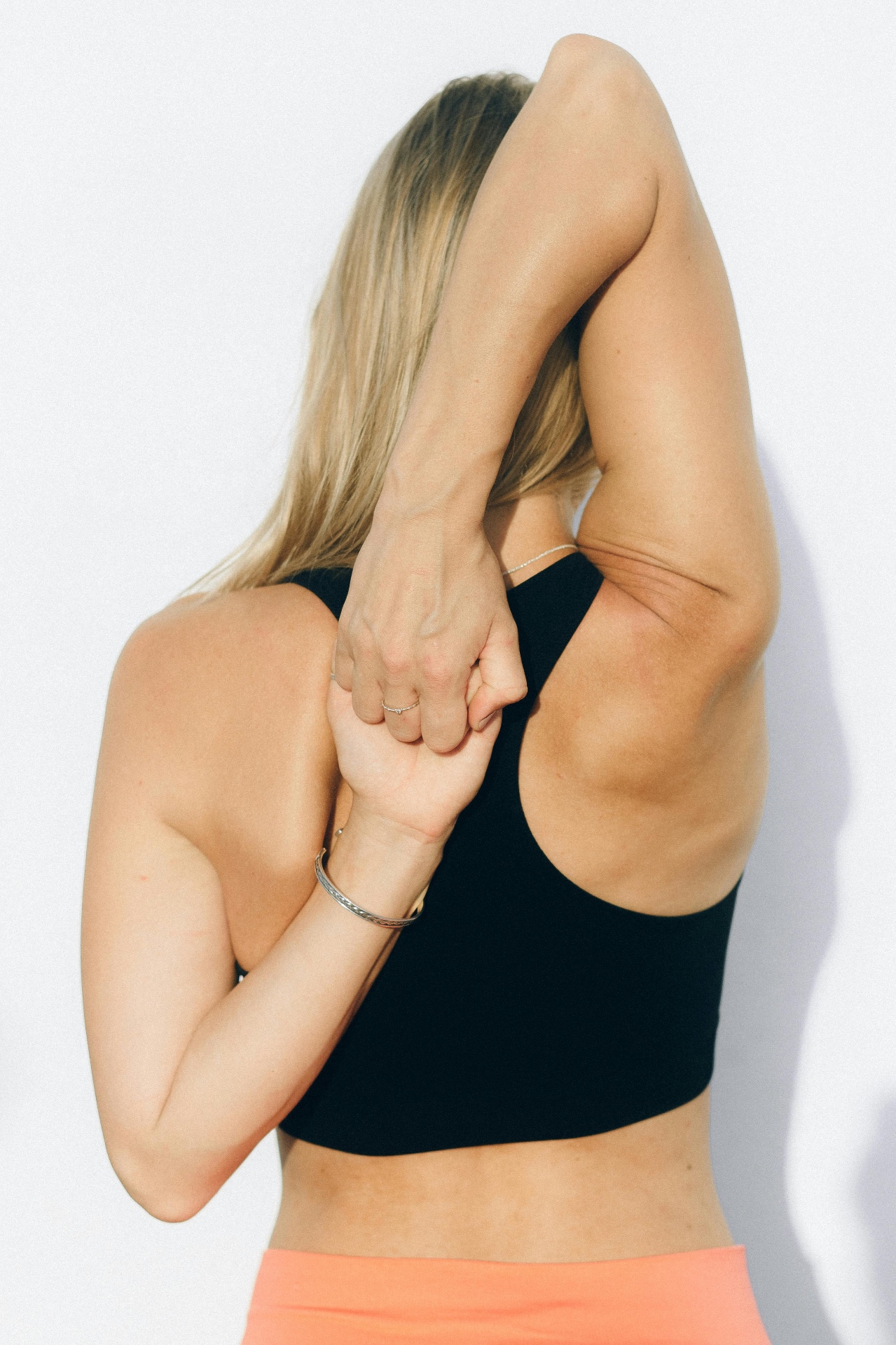 Regular mobility work through the shoulders and upper back offsets hours spent in a fixed, forward-flexed working position.
How we diagnose the root cause at Physio Flora
Postural pain responds particularly well to the McKenzie method, also known as mechanical diagnosis and therapy. This approach is specifically suited to spinal and disc-related pain, unlike techniques designed for joint or soft tissue conditions elsewhere in the body.
During assessment, we use repeated movement testing to identify your directional preference: the specific movement, such as extension or flexion, that centralises or reduces your symptoms. This single piece of information often shapes the entire treatment plan. In addition, we assess your workstation setup, sitting habits, and daily movement patterns, since these are usually what allowed the problem to develop in the first place.
Our physiotherapy treatment options for postural pain
- The McKenzie method (mechanical diagnosis and therapy). Once we identify your directional preference, we teach you specific repeated movements that reduce and centralise pain, giving you an active tool you can use yourself between sessions.
- Manual therapy and joint mobilisation. Hands-on treatment of stiff segments in the neck and mid-back restores movement that sustained sitting gradually takes away.
- Dry needling. Targeted needling of the upper trapezius, levator scapulae, and other chronically overactive muscles reduces the tension that builds from hours in a fixed position.
- Sports massage. Releasing tightness through the neck, shoulders, and upper back supports the other treatments and improves comfort between sessions.
- Corrective exercise programme. We build a targeted plan to strengthen the muscles between the shoulder blades and the deep neck flexors, since strength, not just stretching, is what holds a better posture in place long term.
- Workstation and ergonomic guidance. Practical adjustments, such as screen height, chair support, and simple rules for working from unconventional spaces, remove the daily triggers that keep reintroducing the problem.
Three physiotherapist-approved exercises to start today
- Chin tucks. Sitting tall, gently draw your chin straight back, as if making a double chin, without tilting your head up or down. Hold for five seconds and repeat ten times. This directly strengthens the deep neck flexors that support good head position.
- Thoracic extension over a chair. Sit with your hands behind your head and gently arch your upper back over the top of the chair, opening the chest. Hold for a few seconds and repeat eight to ten times. This counters the rounded, forward posture that builds through a working day.
- Shoulder blade squeezes. Sitting or standing, gently draw your shoulder blades together and down, as though tucking them into your back pockets. Hold for five seconds and repeat ten times. This strengthens the muscles that keep your shoulders from rounding forward.
If pain increases with any of these exercises, stop and book an assessment before continuing.
Answers to the questions our patients ask most
Is my pain actually caused by posture, or is something else going on?
Often posture is a major contributing factor, but a proper assessment rules out other causes first, since not every case of neck or back pain is purely postural.
Will a better chair fix the problem on its own?
Rarely by itself. Equipment helps, but the muscles and joints usually also need direct treatment and targeted strengthening to resolve the underlying pattern.
How long does postural pain take to improve?
Many patients notice a meaningful reduction within two to four weeks once the directional preference is identified and applied consistently, in line with the adaptation timeline described earlier.
Can I keep working while being treated?
Yes, in almost all cases. Treatment is built around your working reality, not around stopping work altogether.
Do I need imaging, such as an MRI, before starting physiotherapy?
Usually not. Most postural pain resolves with assessment and treatment alone, and imaging is reserved for cases with specific warning signs.
Ready to work without the afternoon ache?
Neck and back pain from a working day does not have to be the price of doing your job well. Good posture is not about sitting perfectly still. It is about giving your spine the strength and movement it needs to handle a long working day.
At Physio Flora, we combine thorough clinical assessment with evidence-based treatment and a genuine understanding of an active lifestyle, wherever it is lived. We see patients from Riviera del Sol, Marbella, Fuengirola, Estepona, Benalmádena, Mijas, and across the region. If you prefer to start remotely, our online spine health programme covers the same principles.
No referral needed. Consultations in English, Dutch, German and Spanish. Same-week appointments available.